SharperPrograms: Treatment for ADD in Adults and Children Home - ADD/ADHD/LD Treatments About SharperPrograms - Clinically Proven ADD and ADHD Treatment ADD and ADHD Software Research on ADD/ADHD/LD Contact Us with Questions about ADD and ADHD Treatments
 
ADD and ADHD information for Parents ADD and ADHD information for Teachers ADD Treatment and Memory Loss - Clinicians About ADD/ADHD and LD Memory Loss due to Head Injury, Stroke or Illness Questions and Answers about ADD, ADHD, LD and Memory Loss Order SharperPrograms Software Now

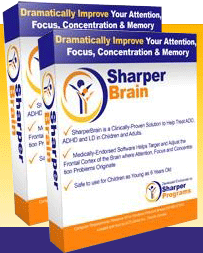
SharperBrain and Sharper Memory

On the Cutting Edge of Research in Computer Programs for Neurocognitive Therapy


How Reorganizing Brainwave Activity Can Help Improve Attention & Memory Deficits of ADD/ADHD/LD

It is estimated that more than 5% of all children in North America have at least one form of learning disability.


Attention deficit disorder (ADD) and attention deficit with hyperactivity disorder (ADHD) are characterized by one or more of the following: inattention, hyperactivity, and impulsivity. Learning disabilities (LD) are characterized by one or more problems with attention, reading, writing, speaking, reasoning, memorizing, and problem solving. Further difficulties may include difficulty organizing and interacting socially.

Many researchers have questioned whether or not attention deficit disorders can be remedied. Treating children and adolescents with stimulants (usually Ritalin) has proven to be helpful, but it’s limited by side effects and tolerance. The introduction of neurofeedback has offered new hope for parents who want to help their children without the use of drugs. Neurofeedback research has shown that training brainwave patterns can remedy attentional difficulties associated with ADD/ADHD/LD.

Brainwaves and Attentional Shifting

The brain produces different frequencies for different levels of attention. They include the following:

How Brainwaves WorkDelta - sleep state
Theta - between sleep and awake, also a meditative state
Alpha - relaxed state
Beta 1 - focused concentration
Beta 2 - alert state
Beta 3 - very alert, vigilant
Beta 4 - hyper-vigilant

The ability to produce the right states, especially those associated with focus and attention, is essential to performing a variety of cognitive tasks. In addition, the ability to shift from one state to another when required offers great mental flexibility, which results in enhanced performance in every area of life.

Using Neurofeedback to Treat Attentional Difficulties

Neurofeedback, which is a type of biofeedback, has been used for more than 20 years to treat concentration difficulties associated with ADD/ADHD and LD. In
general, neurofeedback uses an electroencephalograph (EEG) recording system and training software to enhance the brainwave activity that is instrumental in
improving concentration.

Neurofeedback is based on research that established that individuals with poor concentration lack sufficient levels of Beta 1 brainwaves to sustain attention. (This frequency band is sometimes called SMR, for sensory motor rhythms.)

The findings also showed that individuals with attentional deficits exhibit excessive amounts of slow brainwave activity, especially Theta waves. Joel Lubar, a pioneer in this field, demonstrated that therapies focusing on adjusting the Beta 1/Theta ratio are very effective in treating children with attention deficits and learning disabilities and usually result in improved school performance and better behavior control.

During neurofeedback sessions, the subject responds to feedback from an EEG machine, learning to increase Beta 1 and decrease Theta. After a certain amount of training, typically 40 to 60 sessions, the individual is able to produce more Beta 1 at will. Lubar also proved that all children with any form of learning disability manifested low Beta 1 activity and that many of their symptoms diminished after a course of brainwave training.

Neurofeedback treatment can also significantly improve intellectual functioning, as measured by increases in IQ scores (Linden, Habib & Radojevic 1996). Such improvement is most likely the result of the treatment's positive effect on the ability to concentrate. More recently, Monastra (2002) found that neurofeedback has proven successful in long-term improvement of ADD/ADHD symptoms. In this study, 100 children, aged six to nineteen years, diagnosed with ADD/ADHD, were monitored for one year.

All children received parental counseling, academic support, and Ritalin. Half of the children also received neurofeedback training. After 12 months, all children showed improvement in the ability to pay attention. However, children who stopped taking Ritalin and had not trained with neurofeedback lost the gains they had made, whereas those who had received brainwave training kept their gains even after they stopped using Ritalin.

SharperBrain represents the cutting edge of research in computer programs for neurocognitive therapy. Read more about how it works here.

For clinicians, we have a more detailed article on the subject that includes a comparison of neurofeedback and SharperBrain and provides case studies.


Click Here to Order

Stay Up to Date!

Get the Latest ADD/ADHD News Delivered to Your
E-Mail!

Enter Your Name:
Enter your Email:


  Your information is always kept secure, private and confidential at all times.


Testimonials for SharperBrainClick Here to Read User Testimonials

Medical EndorsementsRead Medical Endorsements for SharperBrain

SharperBrain ComparisonCompare SharperBrain to Other Treatments

Slide Show PresentationWatch a Website Slideshow on How SharperBrain Works


Click Here to Order SharperBrainClick here to order SharperBrain Online or by Phone, Mail or Fax

100% Money Back Guarantee
Your Success is Guaranteed or Your Money Back!