Phone: 647.439.8416
Email:
info@sharperprograms.com


SharperBrain and Neurofeedback:
What’s the Difference?


HARDWARE, SOFTWARE, PhD?

 
Neurofeedback is one type of biofeedback. Biofeedback is a training technique that enables an individual to develop some control over body functions that normally are involuntary. It does this by detecting physical responses, such as changes in skin temperature, and feeding that information back to the subject, who can immediately see that a specific thought or action produced the change. The goal is to learn and to reinforce thoughts or actions that create the desired response. For example, biofeedback may be useful in controlling chronic tension headaches by teaching the subject to relax at will.

Neurofeedback uses an electroencephalograph (EEG) machine to record neural impulses produced by the brain. Most often, this must be done in a clinical setting, under professional supervision. The EEG connects to the subject by electrodes, or sensors, attached to the surface of the scalp or forehead. A mild abrasive gel or witch hazel may be used first to clean the skin, and the sensor is   held in place with a wax paste. Additional sensors may be clipped to the ear or placed at the back of the neck or the base of the thumb. Another method uses a special cap with built-in sensors. All methods send the recorded data to a computer, which processes it and provides appropriate feedback.

Even when neurofeedback can be practiced outside a clinical setting, it requires a special EEG unit that can be attached to a personal computer, as well as training to use the equipment, attach the electrodes, and administer the protocol.

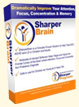
In contrast, SharperBrain can be used at home, without professional supervision, and it was designed to work without EEG feedback. A built-in scoring system provides the feedback that tells users whether they’re getting the desired results. The program reports both general progress and areas of special difficulty and records the results on floppy disk. These results may be uploaded for analysis by a professional supervising the program.

WHAT DO THEY DO?

The two techniques differ in other important ways. Most neurofeedback protocols focus on developing sustained attention, by encouraging the production of Beta 1 brainwaves and by inhibiting slow Theta brainwaves. Other aspects of attention, such as selective attention, orienting of attention, and executive attention, are not usually reinforced.

But these aspects are critical in developing the well-rounded cognitive skills essential to listening, reading, learning, problem solving, following instructions, and interacting responsibly in various settings. Unlike neurofeedback, SharperBrain trains for cognitive skills on the most fundamental level. It not only enhances Beta 1 brainwaves, but also reinforces Beta 2, important for alertness. In addition, the program enables users to practice the lows and highs of each frequency band and trains them to quickly shift from one band to another (Alpha, Beta 1, Beta 2), thus developing better attentional flexibility.

Location matters too. Because neurofeedback is almost always administered in a clinical setting, the practice environment is usually quiet; it doesn’t come close to a typical learning environment. But SharperBrain trains users to meet cognitive challenges against both visual and auditory distractions, enabling marked improvement in the ability to concentrate, even in a noisy classroom.

HOW FAR MUST YOU TRAVEL?  HOW LONG WILL IT TAKE?

You’d have to make at least 40 trips to that neurofeedback clinic. It requires that many sessions or more--after testing and evaluation--to establish durable results for ADD/ADHD. Other conditions, such as head injury or stroke, may take many more sessions to obtain the desired results. Those sessions can each last 30 minutes to more than an hour.

SharperBrain can be used at home. It requires 3 to 5 sessions a week, about 20 - 25 minutes each. You’ll probably see results in less than 6 weeks--sometimes much less--and you can expect them to be permanent, usually with 3 to 6 months of practice.

WILL YOU HAVE TO MORTGAGE THE HOUSE?

The simplest, do-it-at-home neurofeedback set-up, including EEG equipment, training, and professional supervision via email and telephone, starts at approximately $2000. In a clinic, the cost is far more--excluding travel and attendant expenses.

SharperBrain may be used at home for a whole year, with full technical and professional support to ensure results, for US$375. No travel expenses, no special equipment, nothing extra to buy.

SharperBrain is a more efficient way to get help.

See how to order here.

 
Copyright © 2004 SharperPrograms. All rights reserved.